Showing posts with label Greta Magnusson Grossman. Show all posts

Friday, 22 June 2012

Hogarth's Line of Beauty


Self portrait of William Hogarth and an example of the ‘line of beauty’ he used in his compositions. He believed that this curved, S-shaped line excited the viewer’s eye with its energetic movement (as opposed to straight lines or right angles).

Self portrait of William Hogarth and an example of the ‘line of beauty’ he used in his compositions. He believed that this curved, S-shaped line excited the viewer’s eye with its energetic movement (as opposed to straight lines or right angles).


We couldn’t help but recall William Hogarth’s ‘line of beauty’ as defined in his book the Analysis of Beauty (1753) after recently posting a couple photos of objects that exemplify this theory and span two centuries! Here we have reposted Greta Magnusson Grossman’s 1950s Grasshopper floor lamp next to the Louis XV bureau sold this month at Artcurial. Hogarth’s theory is most often referenced in painting but we believe it can also be applied to Design. Perhaps this similarity speaks to the fact that both of these objects are icons of design. We personally think this light works quite well next to this bureau!

Thursday, 21 June 2012

Collectable Lighting


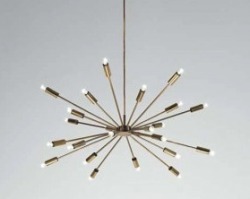
Here are two lamps we love from 1950!  The Grasshopper floor lamp by Greta Magnusson Grossman and the Sputnik ceiling light by Gino Sarfatti.
Last Saturday we attended a Master Class Talk at Design Miami Basel on Collectible Lighting of the 20th and 21st Centuries. The panel included included Didier Krzentowski of Galerie Kreo in Paris, Evan Snyderman of R 20th Century in New York and Marco Romanelli, the Italian designer and critic. Some of their tips on acquiring collectible lighting included:
1. Buy the history or the story of an object rather than basing a decision solely on aesthetics.
2. Understand what an object meant when it was designed - was it revolutionary in its time? If so, that quality makes it collectible.
3. Rarity, of course is important.
4. Buy the best! This might sound obvious but it’s worth stating here… There is a world of difference between a small collection of important examples in lighting design history versus a large amount of lesser items.
5. Do your research and/or seek the advise of an expert.